What is an influencer? A career, types, and actual income in Thailand in 2026.
Meaning, types, and actual income of influencers in Thailand in 2026, along with how to get started.
Short answer: Influencers are individuals with a large following on social media who influence their followers' opinions or purchasing decisions. They can generate income through various channels, including sponsored content reviews, affiliate marketing, platform revenue sharing, and even Live Commerce (One-Stop-Trip-One Partnership) – making it both a primary career and a source of supplemental income.
Imagine this — you're scrolling through TikTok late at night and you see a girl reviewing a sunscreen. She speaks naturally, not from a script, saying she's been using it for three months and her skin hasn't gotten any darker. The next morning, you search for the cream's name on Google and order it within an hour.
That's the power of an influencer.
It's not a billboard advertisement, not a TV commercial that everyone skips — but an ordinary (or extraordinary) person that the audience trusts and listens to.
What is an influencer? Meaning and origin.
An influencer is... Individuals who influence the thoughts, decisions, and behaviors of others through social media channels such as Instagram, TikTok, YouTube, or Facebook.
The word Influencer means... The word "influence" comes from the English verb "influence," meaning "to affect" or "to have an influence on." Adding "-r" makes it a noun referring to a person who "has influence over other things."“
But what sets influencers apart from regular celebrities is:
- intimacy — Influencers communicate with their audience like friends, not just posting pretty pictures.
- A clear niche — Most of them focus in great depth on one particular topic, such as sensitive skin, Keto diet recipes, or laptop reviews.
- Self-built credibility — Not famous because of promises, famous because of content that people trust.
- Real engagement — People comment, ask questions, answer, and share; they don't just press like and move on.
Simply put, if someone says, "Try buying it and you'll see how good it really is," the listener is an influencer.
What does the term "influencer" mean? What do they do in a daily life?
What is the profession of an influencer? Consistently creating content on social media platforms is essential to building a trusted audience and generating business revenue from that audience.
What is the profession of an influencer? Definitely not unlike YouTuber, Blogger, or Content Creator — only with a broader scope, covering all platforms.
The daily lives of most influencers consist of:
Content Planning
Brainstorm themes, ask questions that the audience wants to know, schedule posts, and coordinate with sponsoring brands.
Filming and editing
Shoot videos and take photos, write captions, and edit them to be captivating in the first 3 seconds, because the algorithm observes how long people pause to watch.
Engaging with the Audience
Respond to comments, reply to DMs, read feedback, because this is what makes your audience feel "connected," not just "following."“
Brand Partnership event
Coordinate the brief, receive products for testing, film according to the concept, send content for brand approval, and report on performance.
Who are the different types of influencers in Thailand?
Who are some influencers? In Thailand, there are two main ways to categorize followers: by the number of followers and by niche.
Segmented by number of followers
| level | Follower | nature |
|---|---|---|
| Nano Influencer | 1,000–10,000 | High engagement, low cost, ideal for SME brands. |
| Micro Influencer | 10,000–100,000 | The market's sweet spot — reasonable pricing and good engagement. |
| Macro Influencer | 100,000–1,000,000 | Broad reach is ideal for brand awareness. |
| Mega / Celebrity | 1,000,000+ | Maximum impact, highest price |
See details of each Tier and compare the advantages and disadvantages here → What's the difference between KOL and Influencer?
Categorized by Niche (specialty).
- Beauty Influencer — Reviews of cosmetics, skincare, and beauty products.
- Food Influencer — Restaurants, recipes, Thai street food.
- Travel Influencer Accommodation, tourist attractions, travel tips.
- Tech Influencer — Reviews of notebooks, smartphones, and gadgets.
- Finance Influencer — Investment, saving money, taxes
- Gaming Influencer — Streamer, Game Reviewer, Esports
- Lifestyle Influencer — Daily life, fashion, fitness
- Mom / Parenting Influencer — Raising children, toys, school
The narrower the niche, the more specialized the audience, and the higher the conversion rate compared to influencers with a broad niche and diverse audience.
Where does an influencer's income come from?
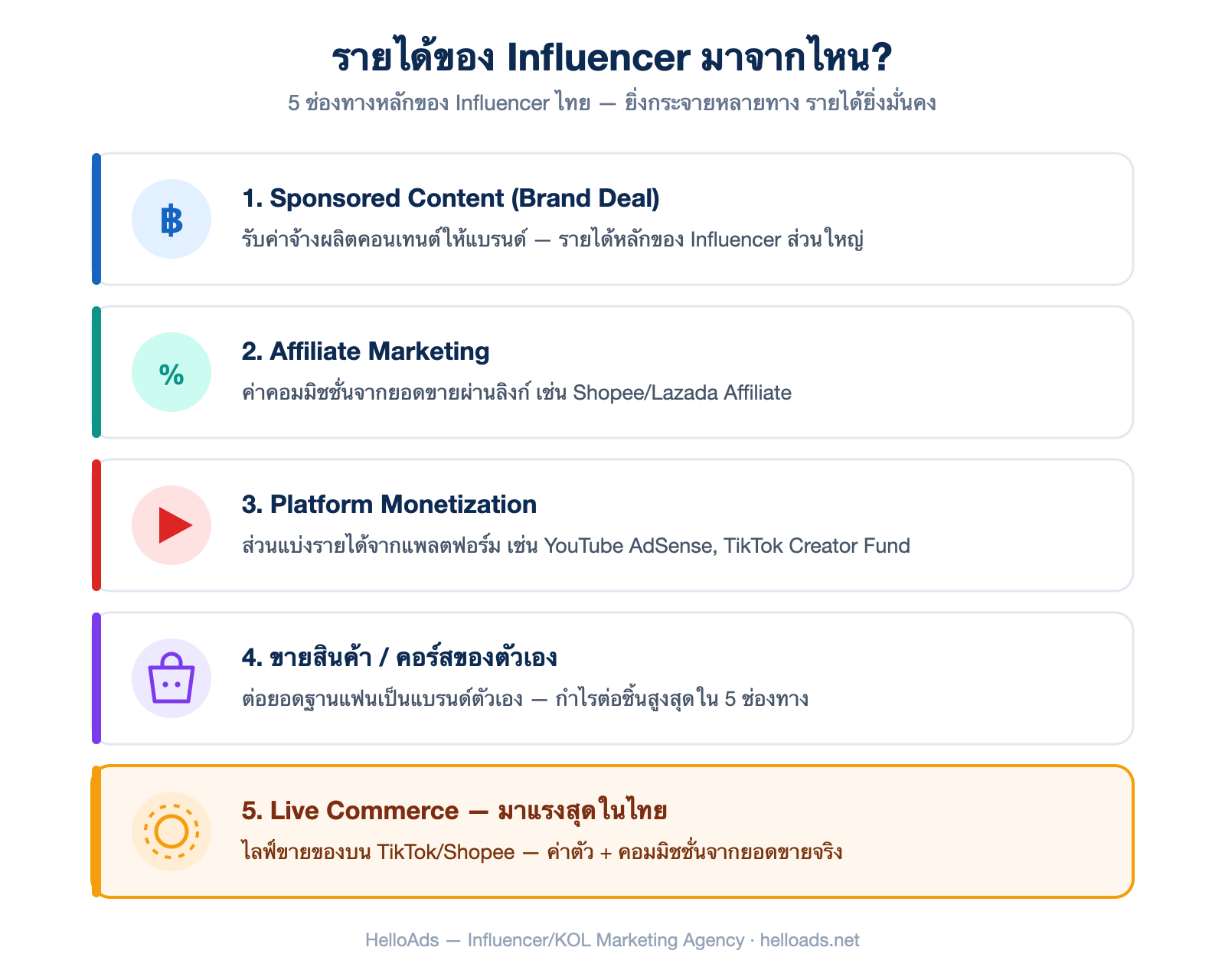
Many people wonder why... Being an influencer is a profession Is it true? Can you really make money? The answer is — yes, and there are many ways to do it.
1. Sponsored Content (Brand Deal)
Brands hire influencers to review products, post photos with products, or create short videos on TikTok/Reels. Income depends on the influencer's level and the platform.
Approximate price for Instagram Post:
- Nano (1K–10K): 500–3,000 baht
- Micro (10K–100K): 3,000–20,000 baht
- Macro (100K–1M): 20,000–150,000 baht
See the detailed price list broken down by platform here → Rate Card: Influencer Hiring Prices 2026
2. Affiliate Marketing
Earn commissions when your audience purchases products through special links, such as Shopee Affiliate, Lazada Affiliate, without needing to stock inventory yourself.
3. Platform Monetization
- YouTube — AdSense video ad revenue requires 1,000 subscribers and 4,000 watch hours.
- TikTok Creator Fund / TikTok Shop — Revenue based on Views and Live Commerce
- Facebook Stars/Reels Bonus — For Creators who meet the criteria.
4. Sell products/courses yourself
Influencers who are highly trusted by their audience often sell private label products, online courses, or memberships directly through their own channels, resulting in significantly higher profit margins than brand deals.
5. Live Commerce
Sales from Live TikTok, Shopee Live, and Facebook Live sessions, where customers purchase products directly from influencers during the live broadcast, are growing significantly in Thailand during 2024–2026.
What is Influencer Marketing? Why are brands rushing to use it?
Influencer Marketing is... A marketing strategy where brands hire influencers to promote their products or services, leveraging the influencer's credibility and audience.
What is Influencer Marketing? In practice? Simply put, instead of the brand talking about itself, it has someone else that the audience trusts speak on its behalf.
Why it's more effective than regular advertising:
- reliability — Nielsen found that 92% consumers trust recommendations from people they know more than direct advertising.
- Ad Fatigue — The average person sees 6,000–10,000 ads per day. Their brain automatically filters them out, but it doesn't filter content from people they follow.
- Accurate targeting — Choose influencers whose audience directly matches your target group. For example, if you're selling supplements for new mothers → find Mom Influencers.
- UGC (User Generated Content) — Content created by influencers can be reused for paid ads, saving on production costs.
The global Influencer Marketing market is projected to reach approximately $24 billion by 2026, up from $1.7 billion in 2016. In Thailand, this market continues to grow due to higher-than-average social media adoption rates compared to the global average.
Successful Thai influencers — What can we learn from them?
There are many examples in Thailand of people who started as "ordinary people" and then became influencers sought after by brands.
Food & Lifestyle
Channels YouTube and TikTok review Thai food and have grown because the channel owners are genuine food lovers, not actors. Their sincerity and consistency are the reasons why millions of viewers follow them.
Beauty & Skincare
Influencers specializing in sensitive or dark skin tones, which are often difficult to research, have become micro-influencers with extremely high engagement rates because they cater to a niche that major brands rarely address.
Finance & Investment
Influencers who explain investing, taxes, and funds in simple, everyday language, rather than technical jargon, have become trusted sources that FinTech brands and banks want to collaborate with.
Gaming & Tech
Streamer and YouTuber review hardware by starting with purchasing the equipment themselves and reviewing it honestly. Their honesty to their audience builds brand trust more than influencers who review everything without actually using it.
What all successful influencers have in common: They started by creating content that they wanted to watch themselves. It's not something that people thought would "be popular."“
How to Start as an Influencer — What to Do if You Want to Try
Step 1 — Choose a niche that you truly know and are passionate about.
Don't choose it just because it's "trendy." Choose it because you can talk about it endlessly, as you'll need to create hundreds of pieces of content on this topic in the first 1-2 years.
Step 2 — Choose a platform that suits your niche.
- TikTok — Fast growing, suitable for Entertainment, Food, Beauty, and Trends.
- Instagram — Beautiful photos, lifestyle, fashion, travel
- YouTube — In-depth content, lengthy reviews, Tech, Finance, Tutorials
- Facebook — Effectively reaches Thai people aged 30+ (Community, Page).
Step 3 — Establish a realistic posting schedule.
Consistency is more important than frequency. Posting 2 times a week consistently is better than posting 5 times a week and then stopping for 2 months. The algorithm values creators who are consistently active.
Step 4 — Engage first, then request engagement later.
Respond to every comment within the first hour of posting. The algorithm will push the post to higher visibility if there's high engagement in the initial period. Ask questions in the caption to encourage replies.
Step 5 — Don't pitch your brand too soon.
Audiences will immediately recognize if an influencer accepts every job for money. Build credibility for 6-12 months first, and brand deals will come to you. Or, if you want to pitch, wait until you have 10,000 followers and have your own case study to show the brand.
What's the difference between an influencer and KOL?
- Influencer — The influence comes from social media followers and engaging content.
- KOL (Key Opinion Leader) — Influence comes from expertise in a specific field, such as doctors, economists, or renowned chefs.
KOL: Anyone can be an influencer, but not every influencer is KOL. Read about the detailed differences here → What is a KOL? How is it different from an influencer?
In summary — What will an influencer be in 2026?
An influencer is someone who builds trust with their audience through consistent and genuine content, not just someone with a large following.
By 2026, this term will be incredibly broad. From high school students reviewing school snacks to investors with hundreds of thousands of podcast listeners, anyone can be an influencer in their field if they have a listener and people believe in them.
For brands wanting to use Influencer Marketing, the most important thing isn't the number of followers, but the influencer's audience. Does this match your customers' needs?
If you want the HelloAds team to help you find the right influencer, create a brief, and manage your campaign from start to finish → View Influencer Marketing services.
Frequently Asked Questions (FAQ)
What is an influencer?
Influencers are individuals who influence the decisions of others through social media, relying on their credibility and the trust their audience has in them. Unlike celebrities, influencers create content and have a direct relationship with their audience.
What does the word "influencer" mean?
The word "influencer" comes from the Thai word "influence" (meaning to have an effect or influence), with the addition of "-r". As a noun, it refers to someone who has the power to change the thoughts or behavior of others.
How much do influencers earn in Thailand?
Depending on the level: Nano Influencers (1K–10K Followers) start at 500–3,000 THB per post, Micro (10K–100K) are at 3,000–20,000 THB, and Macro (100K–1M) are from 20,000 THB upwards. Additionally, there are income streams from affiliate programs, platform monetization, and direct product sales.
How many followers do you need to be an influencer?
There's no fixed minimum number. Nano Influencers with only 1,000–5,000 followers but high engagement and a clear niche can still find brand work. More important than quantity is the quality of the audience and engagement rate.
Is Influencer Marketing truly effective for Thai businesses?
It works when you choose influencers whose audience aligns with your product, measure results based on engagement rate, not just followers, and have a clear brief from the start. Many Thai SMEs start with 2-3 micro-influencers and achieve better results than running direct ads.