What is a KOL? How does it differ from an influencer? And which type should you use to get the most out of it?
Explain the difference between KOLs (Key Opinion Leaders) and Influencers, along with their rate cards and how to choose the right one for your business.
Short answer: A KOL (Key Opinion Leader) is an individual with specialized knowledge or expertise whose opinions influence the decisions of a large following. Unlike typical influencers, KOLs emphasize their expertise rather than the number of followers.
Clients calling for advice on new online marketing strategies often ask the same question: "I want to hire influencers to review my products, but I don't know the difference between KOLs (Key Opinion Leaders) and influencers. Which is better to hire?" This question sounds simple, but the answer really impacts budget and results. This article will explain it clearly, without resorting to textbook jargon.
What is a KOL?
KOL stands for Key Opinion Leader It sounds formal, but to explain it in the simplest way, it means "someone whose opinion carries exceptional weight on a particular issue."“
Think of doctors who talk about medicine and people believe them, investors who analyze stocks and have a real following, or chefs who review restaurants and people follow them. That's a KOL (Key Opinion Leader). They don't need millions of followers, but those followers truly believe and listen to them.
This is very important because a KOL (Key Opinion Leader) might only have 5,000–10,000 followers, but if their 90% (Key Opinion Trends) customers buy the products they recommend, the KOL's value could be higher than an influencer with 500,000 followers who has no interest in the products they post about.
What is an influencer? How is it different from a KOL (Key Opinion Leader)?
An influencer is someone who has an influence on the decisions of their followers through social media. These two terms are often used interchangeably, leading to confusion. The truth is:
| criterion | KOL | Influencer |
|---|---|---|
| Sources of influence | Expertise / Real-world experience | Popularity / Content that people like |
| Audience size | Unlimited, but with higher engagement. | It is usually measured by the number of followers |
| Specialization | Very clear (doctors, investors, chefs, photographers) | Broader (lifestyle, beauty, food) |
| reliability | Very high within a specific target group. | It depends on the platform and content. |
To put it simply: Every KOL (Key Opinion Leader) can be an Influencer, but an Influencer isn't always a KOL. The difference lies in whether that influence comes from "knowledge" or "popularity."“
A visual comparison table of KOLs vs. Influencers.
| section | KOL | Influencer |
|---|---|---|
| Strengths | Specialized expertise | Lifestyle and relationships with followers. |
| Trust comes from... | Proven factual knowledge | Identity and personal preferences |
| Suitable for the product | Products that require careful consideration before purchase include health, finance, and technology. | Mass-produced products that focus on trends and awareness. |
| Key indicators | Reliability and conversion | Reach and engagement |
In short: KOLs sell with their "knowledge," while Influencers sell with their "personality." Products that require rational decision-making are suitable for KOLs, while trendy products are suitable for Influencers, and the most effective campaigns often combine both.
KOL, KOC, and their roots in the Chinese market — a topic often overlooked.
KOL stands for Key Opinion Leader.“ The roots of this concept stem from the opinion leader theory of communication, which existed long before the social media era. However, what made KOL widespread in the digital marketing world and become a standard term is the Chinese social media ecosystem, where Weibo, Xiaohongshu (Xiaohongchu), and Douyin have all used KOL as their primary sales mechanism from the start.
For this reason, there's another word that always goes hand-in-hand with it, and which Thais are hearing more often: KOC (Key Opinion Consumer) — "Influencer consumers" is a term originating directly from the Chinese e-commerce industry. It refers to real users who provide reviews based on their own experiences. They may not have many followers, but people trust them because they appear to be ordinary individuals who actually buy the products.
| type | The influence comes from... | General followers | Suitable for |
|---|---|---|---|
| KOL Key Opinion Leader | Specialized expertise | Hundreds of thousands to millions | Building credibility for products that require knowledge to make decisions. |
| KOC Key Opinion Consumer | Real-world experience | Thousands to tens of thousands | Create a large number of reviews to make it look like a natural trend. |
| Influencer | Popularity on social media | various | Create widespread awareness |
Why Thai brands should know this: If your business plans to sell to Chinese customers, whether it's Chinese tourists in Thailand or exporting to China, almost all marketing strategies on Chinese platforms are based on the KOL and KOC systems. Generating a large number of reviews from KOC onto a Xiaohongshu platform is often more effective than hiring a single large KOL, which is a different logic than hiring influencers in Thailand.
For an in-depth look at the Chinese side, please visit: The difference between KOL and KOC in the Chinese market. · Get to know Chinese influencers and the different types of KOL roles. Or see HelloAds's China marketing services.
What are the differences between the types of influencers — Nano, Micro, Macro, and Mega?
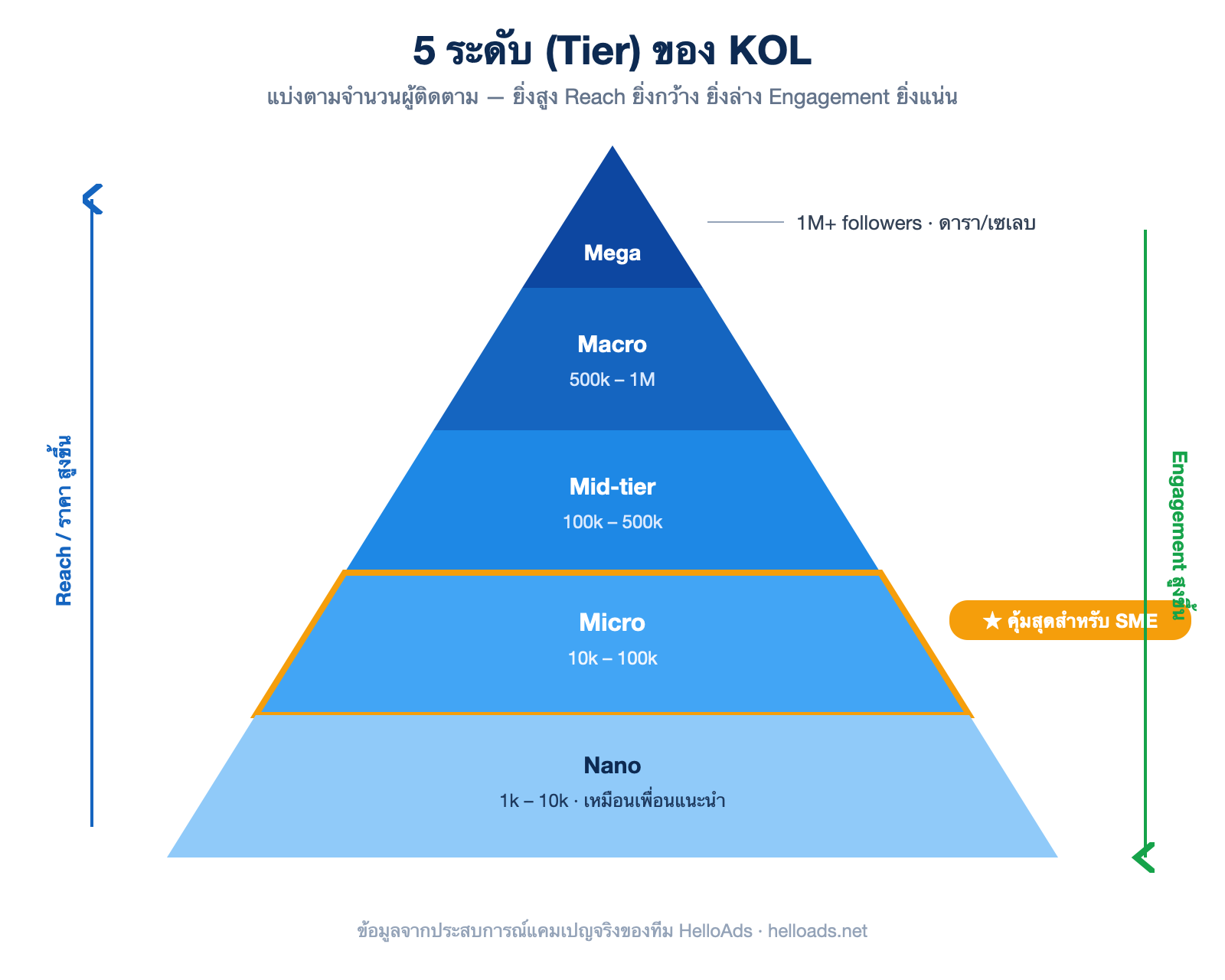
Before we get to the budget and selection process, let's understand the "Tiers" of influencers, because the price and results vary greatly.
Nano Influencer (1,000 – 10,000 followers)
Nano influencers have the fewest followers but the highest engagement rate because most of their followers actually know each other. Think about it: would you trust a restaurant review from a classmate or an advertisement from a brand more? That's the power of nano influencers. They're ideal for local products or brands looking to build credibility within a specific community.
Micro-influencer (10,000 – 100,000 followers)
This segment is the sweet spot for most brands right now. They offer reasonable pricing, good engagement, and often specialize in niche topics such as beauty, food, fitness, or travel. If you have a limited budget but want measurable results, micro-marketing is the answer.
Macro Influencer (100,000 – 1,000,000 followers)
This reach is very broad, suitable for brand awareness at a national level. The budget is higher accordingly, but if you want to quickly increase brand recognition on a wide scale, this group is the best.
Mega Influencer / Celebrity (1,000,000+ followers)
Celebrities, singers, and athletes command very high prices and have lower engagement rates than other groups. However, if what you want is for "everyone to see it in one day," there's no shortcut. This is suitable for product launches or brands with a sufficiently large marketing budget.
Why are more Thai brands turning to influencer marketing?
Having worked with hundreds of brands over the years, what's become clearer each year is that traditional advertising is becoming less effective, while influencer content remains impactful. Nielsen figures support this — 92% consumers trust recommendations from people more than direct brand advertising.
Reasons why influencer marketing still works in an era of saturation:
- People skip ads, but they don't skip the content they're following. — Pre-rolls on YouTube are skipped within 5 seconds, but review videos from your favorite influencers? Watch them to the end!
- More accurate targeting — Choose influencers whose audience matches your customers, without having to run ads indiscriminately.
- Content that can be reused. — The photos and videos created by influencers can be used as creative elements for paid ads without needing to hire additional production services.
- Word of mouth in the digital age. — Influencer marketing is a scalable form of word-of-mouth marketing. People with followers who trust the brand talk about the product.
How to choose the right influencer for your business.
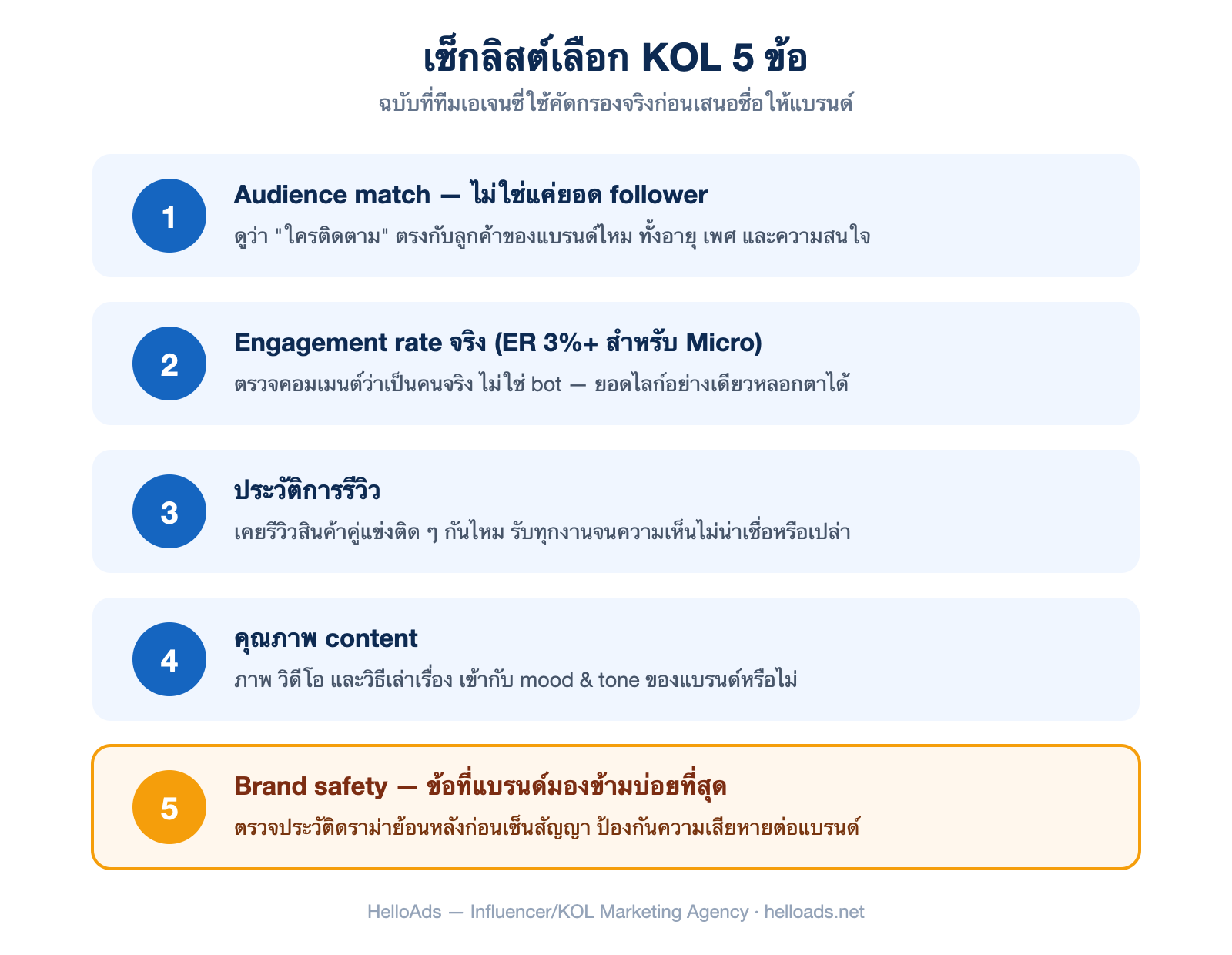
The most common mistake is choosing an influencer based solely on "follower count" and "price." Those two alone don't guarantee effectiveness. There are other, more important factors:
1. Engagement Rate tells you more than Follower Count.
An influencer with 500,000 followers but an engagement rate of only 0.5% means only 2,500 people actually saw their post. Compare this to a micro-influencer with 50,000 followers but a 6% engagement rate, meaning 3,000 people actually saw their post, and those 3,000 people were genuinely interested. A good engagement rate on Instagram should be 3-6% or higher, while TikTok often has even higher rates.
2. Your audience demographics must accurately reflect your actual customers.
Always review Audience Insight before making a decision. If an influencer has 70% followers in other provinces or countries, but you only sell products in Bangkok, that means you're wasting money on people who aren't your customers.
3. Review the feed from the past 3 months before making a decision.
An influencer's content style must match the brand tone. An influencer who posts humorous content every day may not be suitable for products that require a serious image, no matter how many followers they have.
4. Check for fake followers before hiring.
Tools like HypeAuditor or Social Blade can help with this. A sudden surge in follower count followed by a sharp drop, or an unusually low engagement rate, are warning signs.
Rate Card for Thai Influencers — Estimated Price 2026
A very frequently asked question is, "How much does it cost to hire an influencer?" To be honest, there's no fixed price, but here's what we're seeing in the Thai market right now:
| level | Follower | Instagram Post | TikTok VDO | YouTube Review |
|---|---|---|---|---|
| Nano | 1K–10K | 500–3,000 baht. | 500–2,000 baht. | 1,000–5,000 baht. |
| Micro | 10K–100K | 3,000–20,000 baht. | 2,000–15,000 baht. | 5,000–30,000 baht. |
| Macro | 100K–1M | 20,000–150,000 baht. | 15,000–100,000 baht. | 30,000–200,000 baht. |
| Mega/Celebrity | 1M+ | 150,000 THB+ | 100,000 baht+ | Negotiate according to the terms |
The prices shown are reference figures based on current market conditions. Actual prices depend on reputation, content type, complexity, usage rights, and campaign duration. See more details at [link to website/product page]. Full price list for influencer hiring.
KOL Marketing vs. Influencer Marketing — Which is better suited for which situation?
There's no single answer as to which is always better; it depends on the product and its goals.
If the product is needed High reliability For example, supplements, medical devices, B2B software, or financial services — use KOLs who are truly experts in that field, even if they have fewer followers, because their audience genuinely trusts them.
If desired Wide Reach Creating brand awareness quickly — Macro or Mega Influencers do a better job of that.
The most effective campaigns we've seen often use a combination of both approaches — a few KOLs (Key Opinion Leaders) build credibility within the target audience, and then general influencers amplify that reach.
Before hiring an influencer, make sure these 5 points are clear.
What often causes campaigns to fail isn't the influencer themselves, but the lack of a clear plan from the start. Try defining these things before sending the brief:
- target — Awareness, Engagement, or Conversion? Different goals require different influencers.
- Total budget — Includes influencer fees, production costs, and any additional budget that may need to be paid for boosting posts.
- Measurable KPIs — Views, Reach, Engagement Rate, Link Clicks, or Promo Code used to purchase products.
- Timeline — Make it clear from the start, from Brief → Content Review → Live Date → Reporting.
- Usage Rights — How long can brands continue to use content created by influencers, and across what channels?
If both ROI and Deliverables are clearly defined, everything will be clear from day one, eliminating any arguments later.
In summary: What are the differences between KOLs (Key Opinion Leaders) and Influencers, and where should you start?
KOLs (Key Opinion Leaders) are individuals who gain influence through their expertise in a specific field, while Influencers are those who gain influence through their popularity on social media. Both are useful — but choosing the wrong one can be a waste of budget. If your product requires high credibility, choose KOLs. If you want a broad reach, choose Macro/Mega Influencers. And if you have a limited budget but want real results, Micro Influencers are a great starting point.
HelloAds handles every step of influencer marketing.
HelloAds has been working with influencers and KOLs in Thailand for many years across FMCG, Beauty, Tech, F&B, and B2B industries. Our services cover everything from strategy development and selecting the right influencers to managing briefs and content approval, and post-campaign reporting.
If you're unsure which KOLs or influencers to use, or don't know what your budget allows, the HelloAds team is happy to analyze and plan for you free of charge, with no obligation.
Frequently asked questions about KOLs and Influencer Marketing.
What does KOL stand for? What does it mean?
KOL stands for Key Opinion Leader Literally translated, "thought leader" refers to someone whose opinions carry enough weight to change the decisions of others because they possess real knowledge or experience in the matter, not just because they have a large following.
What does KOL in TikTok mean?
KOL within TikTok refers to creators who are trusted in specific fields, such as dermatologists reviewing skincare or technicians reviewing tools. This differs from entertainment creators who have high view counts but aren't necessarily perceived as experts. When buying media on TikTok, engagement rate and comments (whether people are genuinely asking about the product) should be considered more than just view counts. TikTok also has a Chinese version called Douyin, which operates differently within the KOL system.
What does a KOL Specialist do? What qualifications are required?
A KOL Specialist is an agency or brand-side position responsible for selecting, contacting, negotiating prices, and measuring campaign performance. KOL candidates don't have a specific academic background; they typically come from fields like communication, marketing, or digital. Employers value experience in managing real-world campaigns and a strong understanding of data more than academic qualifications. Note: This page is written for brands that are hiring KOL. If you are looking for a job in this field, career insights should be sought directly from job websites.
What is the difference between a KOL (Key Opinion Leader) and an Influencer?
Key Opinion Leaders (KOLs) gain influence through their expertise in specific fields, such as doctors, investors, or chefs. Influencers, on the other hand, are primarily influenced by their popularity on social media. Any KOL can be an influencer, but not every influencer is a KOL.
What is a micro-influencer?
Micro-influencers are those with 10,000–100,000 followers. They typically have higher engagement rates than macro-influencers and their fees are more reasonable. They are suitable for brands seeking tangible results on a moderate budget.
How much does it cost to hire an influencer?
Influencer hiring rates in Thailand vary depending on the level: Nano (1K–10K Followers) starts at 500–3,000 THB, Micro (10K–100K) is 3,000–20,000 THB per Instagram post, and Macro (100K–1M) starts at 20,000 THB and up. Actual prices depend on the platform, content type, and usage rights. See more details at [link]. Full price list for influencer hiring.
Should I choose a KOL or an influencer for my product?
If your product requires high credibility, such as supplements, medical devices, or B2B services, choose KOLs (Key Opinion Leaders) who are true experts in that field. If you want broad brand awareness, choose Macro/Mega Influencers. If your budget is limited, start with Micro Influencers.
Does influencer marketing really work?
It works when you choose influencers whose audience aligns with your product, measure results based on engagement rate (not just followers), and have a clear brief planned from the start. According to Nielsen data, 92% consumers trust recommendations from individuals more than direct brand advertising.Reference: Nielsen Global Trust in Advertising)
Read more in the Influencer Marketing series.
- Influencer Hiring Rates 2026 — Rate Card for All Platforms
- What is an influencer? A career, types, and actual income in Thailand in 2026.
- How to Find Influencers for Product Reviews — Platforms, Pricing, and a Checklist Before Hiring.
- What are the differences between Nano, Micro, Macro, and Mega Influencers? Which Tier is the best for your budget?
- What is a Shopee KOL? How to register and earn money with the Shopee KOL Program.
- What are AI Influencers and Virtual Influencers? A brand trend in Thailand in 2026.
About the author: The Influencer Marketing team at HelloAds (Hello Ads Co., Ltd.) – a digital marketing agency in Bangkok with over 10 years of experience – has managed KOL/Influencer campaigns for more than 100 Thai and international brands in both the Thai and Chinese markets. With a database of over 10,000 KOL/KOC influencers, inquire about campaign planning. Influencer Marketing Services